


Just 30 years ago, osteochondrosis was associated exclusively with older people, whose joints became immobile and hurt with every movement.However, times have changed.Today, more and more people are changing hard physical work for sedentary work at the computer, paying less and less attention to the quality of their diet, and are increasingly faced with osteochondrosis of the cervical spine.It is not for nothing that osteochondrosis is called the "disease of the century", and almost every person who has turned 25 years old faces the symptoms of this disease.

This insidious disease, which begins with unpleasant pain in the neck, very quickly leads to serious consequences in the form of weakening of hearing and vision, as well as deterioration of memory up to its complete loss.That is why each person should know the causes of osteochondrosis and immediately consult a doctor if unpleasant symptoms of the disease appear.We will talk about them in this article.
Causes of cervical osteochondrosis
Paradoxically, all our problems with the cervical spine begin in early childhood, or rather in primary school, when the child's posture deteriorates and scoliosis develops.It is at this moment that the system that supports the head through the spine is altered, particularly its thinnest and most vulnerable part: the cervical spine.The second key factor in cervical osteochondrosis, which dates back to early childhood, is the lack of physical training, in particular the weakness of the spinal muscles and the so-called muscular corset designed to support the spine.
These are the two most important causes of the disease.Everything else puts a heavy load on the weakened spine, causing the development of the disease in fairly young and healthy people.First of all, they include a sedentary lifestyle and lack of physical activity, particularly work that involves staying in the same position for a long time.This is more typical in drivers and office workers who spend their shifts sitting in front of the computer.All this is complemented by excess body weight, which considerably increases the load on the spine.
Other causes of osteochondrosis of the cervical spine include:
- previous spinal injuries;
- metabolic disorders;
- hereditary predisposition;
- great physical activity;
- constant nervous tension and stress;
- anomalies of the development of the cervical spine;
- bad habits (holding the headset with your ear and shoulder).
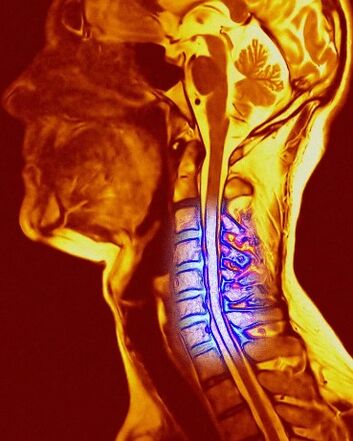
The process of development of osteochondrosis.
The listed unfavorable factors ultimately lead to increased load on the cervical spine.When trying to compensate for the excess load on the neck muscles, their spasm occurs, which causes impaired blood circulation in this area and a decrease in metabolic processes.All this results in the development of degenerative processes in the spine.First, the vertebrae begin to thin and move closer together, compressing their contents (the annulus fibrosus) away from the spine.In medical terms, such a lump is called a protrusion.
In the case of protrusion, the annulus fibrosus still retains its integrity, but the protrusion already compresses the blood vessels and nerves that run through the spine and supply the brain.In addition, the approaching and deforming vertebrae begin to compress the roots of peripheral nerves, which leads to the development of the so-called "radicular syndrome", which manifests itself as severe pain in the back and neck.If the problem is not identified (which will be eloquently signaled by unpleasant symptoms) and osteochondrosis is not treated, the annulus fibrosus will rupture and a vertebral hernia will appear.In this case, serious problems will arise with the nutrition of the brain.
Symptoms of cervical osteochondrosis.
In its development, the disease goes through several stages, each of which presents characteristic signs and symptoms.It should be noted here that osteochondrosis of the cervical spine differs from degenerative changes in other parts of the spine.The distances between the vertebrae here are minimal, and therefore even small degenerative changes cause unpleasant symptoms and lead to various complications.
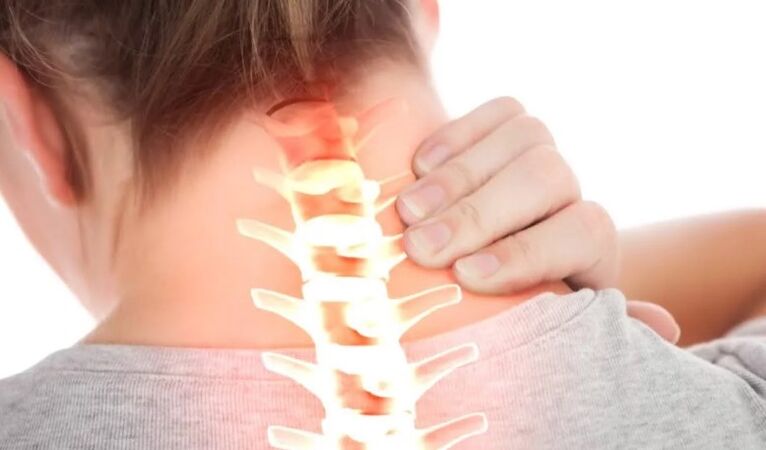 Osteochondrosis I degreeThis is the preclinical stage of the development of the disease, in which the patient experiences mild pain and discomfort when turning his head, as well as tension and fatigue in the neck and back when staying in one position for a long time (usually sitting).At this stage, osteochondrosis can be perfectly treated by changing lifestyle, adjusting nutrition and exercising regularly.
Osteochondrosis II degreeAt this stage, instability appears between the vertebrae of the neck.In this case, the person faces severe pain that radiates to the shoulder, neck or arm.When bending or turning the head, the pain intensifies significantly, since due to a decrease in the distance between the vertebrae, the nerve endings begin to be pinched.The patient begins to tire quickly, his performance decreases, he becomes distracted, forgetful, and suffers from headaches.
Osteochondrosis III degreeWith the onset of the third stage of the disease, the pain in the back and neck becomes even stronger, the mobility of the neck decreases noticeably, and when the neck is rotated, the crunch of the vertebrae can be heard.At night, the patient's fingers begin to go numb (mainly the little finger and ring finger), which is why the person wakes up several times a night.Throughout the day, these patients experience unpleasant heaviness in their hands.And even a short conversation on the phone, during which a person is forced to hold the mobile phone to his ear, causes unpleasant tingling and numbness in the fingers.All this indicates an increase in protrusion and possibly the appearance of a hernia in the cervical spine.
Osteochondrosis IV degreeIn the last stage of the disease, the vertebral discs are destroyed, which stop performing their functions and begin to be replaced by connective tissue.A patient in this condition may experience poor coordination of movements, maddening noises and pulsations in the ears, increased headaches, decreased visual and hearing acuity.In some cases, numbness of the tongue may occur.
Here it must be said that due to the compression of blood vessels, blood flow to the brain is interrupted.Due to this, the patient develops neurotic disorders such as insomnia, nervousness, irritability and resentment, frequent mood swings and inability to concentrate.Outbursts of anger or fear, melancholy and depression may occur periodically.
In the later stages of the development of osteochondrosis, severe vascular spasms can cause the appearance of "floaters" before the eyes, a feeling of instability on a hard, flat surface, severe dizziness, migraines, nausea, vomiting and frequent fainting.
Diagnosis of the disease.
To identify the cause of the pathology, the patient describes to the doctor the unpleasant symptoms of his condition.After listening to the patient, the specialist refers him to one of the following research methods.
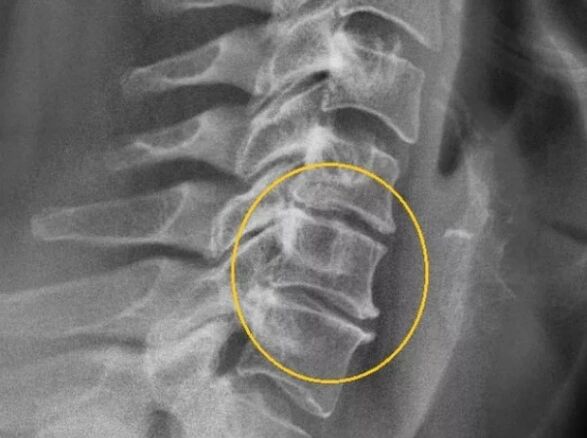
Radiography.Currently, this diagnostic method is considered uninformative, especially in the later stages of the disease.Duplex ultrasound scanning.This method is used in cases where a specialist suspects a disruption of blood flow in the arteries that supply food to the brain.The study shows the speed of blood flow and determines if there are obstacles in its path.CT (computed tomography).This method is more informative compared to x-ray, since it not only identifies the problem, but also makes it possible to determine the presence and size of hernias, although with difficulty.MRI (magnetic resonance imaging).The most informative method for diagnosing osteochondrosis today, which makes it possible to discern bone structures, the presence of hernias and even the direction of their development.
Osteochondrosis treatment
Let's say right away that to combat such a serious problem as osteochondrosis of the cervical spine, it is worth consulting a neurologist.True, if there is a vertebrologist in the clinic, it is better to contact him first.

Osteochondrosis can only be treated comprehensively.The complex of methods used includes drug therapy, massage in the cervical collar area, exercise therapy, physiotherapeutic methods and proper nutrition.Only a combination of all these methods will help to cope with the disease and normalize the patient's well-being.
Helps with severe pain
In case of severe pain, doctors recommend taking medications such as Analgin, Baralgin or Tempalgin.When these medications stop providing relief, you can switch to nonsteroidal anti-inflammatory drugs (Ketanov gels, Ketorolac, Nise, and Diclofenac).
In general sense, pharmacotherapy includes the following:
- NSAIDs (non-steroidal anti-inflammatory drugs).These remedies eliminate pain, relieve swelling and cope with inflammation of the nerve roots.
- Chondroprotectors.These drugs perfectly restore damaged cartilage tissue.
- B vitamins. They are necessary to improve metabolic processes in nervous tissues.
- Muscle relaxants.The action of these drugs is aimed at reducing muscle spasms.
- Medicines that improve the rheological properties of blood.Thanks to these means, the supply of oxygen and nutrients to the brain and nerve endings improves.
It should be noted here that it is possible to achieve a noticeable effect in the fight against osteochondrosis with the help of ointments and tablets only if drug treatment is combined with other methods of therapy.Otherwise, the medications will only give a temporary effect.
Many specialists tend to treat osteochondrosis with injections to quickly act on the nerve endings and save the patient from possible side effects when taking pills.However, it is best to take vitamins orally, because... Vitamins are well absorbed by the body no matter how they are taken, but injections can be painful.
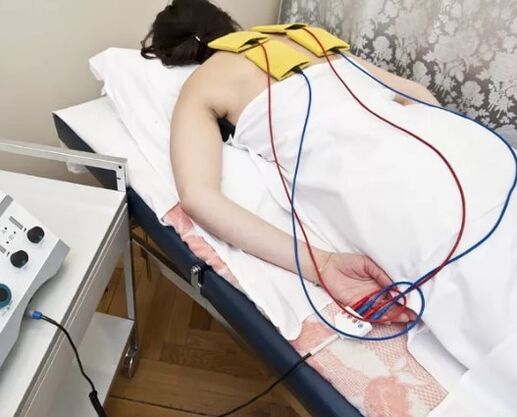
Physiotherapeutic treatments
Drug treatment should be combined with physiotherapeutic therapy methods.The most effective for this disease are:
- Electrophoresis (in combination with medications).In this case, drugs penetrate into the damaged vertebrae under the influence of an electric current.As a rule, electrophoresis is performed with Eufillin to improve blood flow or Novocaine to reduce pain.
- Ultrasound.This method of exposure allows you to relieve the inflammatory process, relieve pain and improve metabolic processes in tissues.
- Magnetotherapy.This type of physical therapy relieves swelling and eliminates pain.
- Laser therapy.This is an excellent method of combating inflammatory processes, which also improves blood circulation.
Diet for osteochondrosis
Restoration of the affected vertebrae also includes a special diet that normalizes metabolic processes in the body, prevents salt deposition, nourishes and restores cartilage tissue, and also strengthens the ligaments between the vertebral discs.
To achieve this, first of all the following must be excluded from the patient's diet:
- alcoholic beverages;
- fatty and fried foods;
- spicy and overly salty dishes;
- strong broths;
- weaknesses and baking;
- strong tea and coffee;
- pickles and marinades;
- canned products.
The diet of a patient with osteochondrosis should consist of the following foods:
- lean meats and fish;
- low-fat milk, cottage cheese and kefir;
- butter (small amount);
- whole grain porridges and soups;
- jellied meat, jellied fish or meat;
- vegetables, fruits and berries;
- Juices, fruit drinks, jellies and compotes.
When osteochondrosis is located in the cervical region, it is important to follow the drinking regimen, drinking at least 1.5 liters of water per day.If you are overweight, you should think about how to get rid of extra pounds, which put additional pressure on the spine.It is advisable to eat 5 times a day in small portions.

At the same time, as follows from the list of foods allowed for consumption, the basis of nutrition should be low-fat vegetarian soups, lean boiled meats, fish, seafood, unsweetened vegetables and fruits.
A sample menu for the day would look like this:
- breakfast: cottage cheese, a couple of apples, unsweetened tea;
- lunch: baked pear, some oatmeal cookies;
- lunch: vegetarian borscht, boiled chicken with vegetable salad;
- snack: dry crackers and fruit juice;
- dinner: baked fish with vegetables and unsweetened tea.
Exercise therapy for osteochondrosis.
Physical education gives amazing results in the treatment of osteochondrosis, although gymnastics for the cervical spine can only be done during the recovery period.Here it is important that during the massage or gymnastics the patient does not feel discomfort or pain.
Good health to you!